

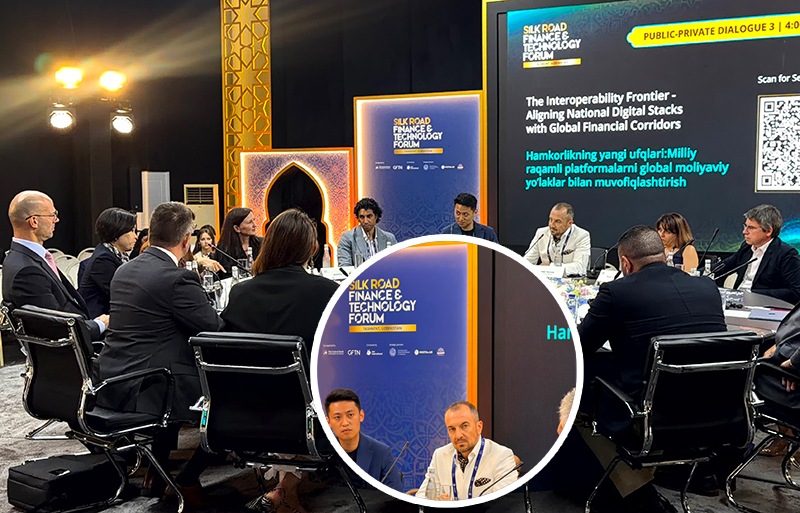
BIPA at the Silk Road Finance & Technology Forum: Standards, Privacy and the Case for an OBIS Pilot
Tashkent, 24–26 August 2026 — The Blockchain Intelligence Professionals Association (BIPA) joined the inaugural Silk Road Finance & Technology Forum as a Community Partner, with Chairman Bogdan Vacusta speaking on the roundtable The Interoperability Frontier — Aligning National Digital Stacks with Global Financial Corridors.
Why Central Asia, and why now
Convened by the Central Bank of the Republic of Uzbekistan and the Global Finance & Technology Network (GFTN), and co-hosted by Ant International, the Forum drew 8,500 delegates from 77 countries — a scale that reflects the region’s shifting position rather than the size of its markets.
Central Asia sits on the corridors that Eurasian trade and capital are being deliberately rerouted through, and its governments are diversifying their partnerships rather than settling into any single bloc. Days after the Forum closed, heads of state gathered in Bishkek for the SCO summit, where an SCO development bank, new investment funds and fresh trade corridors were on the agenda.
Financial infrastructure in this region is being built now.
Uzbekistan’s own strategy makes the stakes concrete. Its Islamic banking framework took effect on 29 June 2026, creating a dual banking system with dedicated licensing and a Council for Islamic Finance at the Central Bank — a deliberate bid for a share of a global Islamic finance market projected to approach $10 trillion by 2029. The Forum’s closing “Azimuth Commitment” named the conditions for that ambition: common taxonomies for Shariah-compliant instruments, mutual recognition across jurisdictions, portable capital and a cross-border regulatory sandbox. Every one of those is a standards problem.
Fragmentation is a decision-making failure
The roundtable, moderated by GFTN’s Anikó Szombati and Maha El Dimachki, examined how sovereign national digital stacks can connect to global corridors without surrendering data security or consumer protection. Bogdan Vacusta spoke alongside H.E. Chea Serey, Governor of the National Bank of Cambodia, and senior figures from Circle, the Central Bank of Hungary, Anchorage Digital, Cobo, Liminal Custody, Kaleido and the Fintech Latvia Association, among others.
BIPA’s contribution moved the interoperability question one layer down. Corridors do not fail only where messages and settlement fail to align; they fail where the evidence about a transaction cannot travel with it. When a payment crosses a border on public infrastructure, the supervisor on the receiving side inherits an on-chain record but no shared way of reading it. Each analytics provider applies its own attribution logic, entity taxonomy, risk scoring and confidence conventions. The same address can carry three different labels in three jurisdictions, none of them wrong, none of them comparable.
“We have spent a decade making the data available and almost no time making it legible. A supervisor cannot act on an assessment they cannot compare, contest or reproduce — and across corridors today, they usually cannot do any of the three.” — Bogdan Vacusta, Chairman, BIPA
The consequence is not technical inconvenience but a decision-making failure: findings that cannot be aggregated across borders, defended in supervisory proceedings, or tested for reliability. Open, non-proprietary standards covering attribution, provenance, methodology disclosure and confidence expression are what close that gap.
Privacy by proof, not by trade-off
Cross-border intelligence sharing is usually framed as a choice between disclosure and protection. Zero-knowledge proofs dissolve that choice. They allow one party to demonstrate that a claim holds — that an address is not sanctioned, that a counterparty cleared a defined due-diligence threshold, that a flow does not touch a designated cluster — without transmitting the dataset, the identity or the underlying records. A foreign authority’s assurance requirement is met while personal data stays inside its own jurisdiction and legal regime.
Standards are what make this operational. A proof means something only if both sides agree on what is being proven, which requires a shared vocabulary for entities, risk categories and assurance levels. Privacy technology and standardisation are the same programme.
An invitation to pilot OBIS
BIPA used the Forum to put a concrete proposal to the institutions present. The Open Blockchain Intelligence Standards (OBIS) initiative — co-convened by BIPA, ICI Bucharest and the Complexity Science Hub Vienna — is developing open standards for blockchain intelligence as a global public good, and is ready to be tested in practice.
The proposal: a national or regional implementation project, sponsored by a central bank or financial supervisory authority, applying OBIS within a defined corridor or sandbox. For supervisors, the return is comparable, auditable and reproducible analytical output across institutions. For the market, an open standard lowers the cost of entry, removes dependence on any single proprietary methodology, and lets providers compete on quality rather than lock-in. Innovation and supervision are served by the same instrument.
“An open standard is the cheapest piece of financial infrastructure a supervisor will ever commission, and one of the most consequential. We are inviting a central bank or supervisory authority to pilot OBIS in a real corridor — and we will bring the convening work to them.” — Bogdan Vacusta, Chairman, BIPA
Building that visibility on open standards from the outset is considerably cheaper than retrofitting it later — and in a region assembling its financial architecture this decade, the window is open now.
BIPA congratulates GFTN and the Central Bank of the Republic of Uzbekistan on the successful inaugural edition of the Forum, and welcomes contact from central banks, supervisory authorities and market participants interested in the OBIS pilot proposal.
Sources: Silk Road Finance & Technology Forum, 24–26 August 2026 (GFTN) · Forum — Our Partners · The Interoperability Frontier — session programme · Forum — End of Day 1 report · Uzbekistan Turns to Islamic Finance as the Forum Enters Final Day · Xi, Modi and Putin attend SCO summit: What’s on the agenda? (Al Jazeera)