


When the signers never transact: proving who stands behind a safe
Can a group run a criminal scheme on a blockchain without any of its members sending a transaction? Patrick Tan, General Counsel of ChainArgos, argues that it can, in the firm’s opinion piece Blockchain Crimes With Nobody to Charge?, published on 17 November 2026. In his view, what makes it possible is not an exploit but the way one of the most widely used multisig products is designed to work. His question is who, if anyone, can then be held to account.
Approval without a transaction
A Safe is a smart contract controlled by a group of owner addresses. It acts only when enough of them, the threshold, have approved a given action: three of five, for example. By the project’s own count, more than 63 million Safe accounts have been deployed, so this is a mainstream design rather than a special case.
What matters is how the Safe separates approval from execution. Owners approve by signing a hash of the proposed action. A signature is data, not a transaction: producing one costs nothing and leaves nothing on the chain. Anyone holding enough valid signatures can then submit them to the Safe in a single transaction.
The contract checks that the signatures come from owners, that they meet the threshold and that the action has not been executed before. It does not check who delivered them. The Safe documentation calls this relaying, with verification kept “independent of msg.sender”. The vault counts the keys, not the courier who brought them.
Owners who never touch the chain
Tan’s construction uses nothing but these standard features. Each member generates a fresh key. The address is computed from the key, so it exists without ever appearing on the chain. The existing owners approve adding that address to the Safe, and someone who is not an owner submits the change.
From then on, every decision follows the same route. The owners sign offline. The signatures go to a submitter, who sends the only transaction and pays the gas from its own address. Any gas refund the Safe makes is directed to a non-owner too.
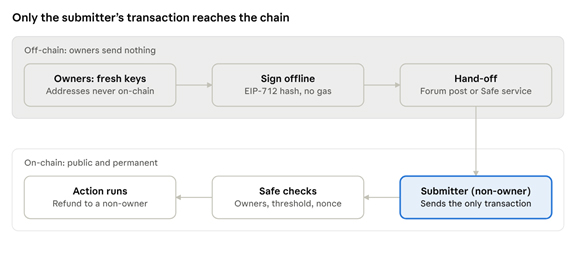
Figure 1 – Offline signing in a Safe · 6 steps, two lanes
Everything above the line leaves no record on the chain; the one transaction that reaches it is the submitter’s.
The signatures do not even need to travel privately. Tan sketches an owner who creates a single-use email account over a VPN, opens a single-use account on a governance forum, posts the signature once and never returns. Anyone can check that the signature belongs to the right owner, because the signing address can be recovered from it.
The result is a group that operates a system and changes it by vote, while no owner address ever sends a transaction or receives funds. The usual money trail back to the owners does not exist, because no money ever moves towards them.
Keys on the record, people off it
None of this makes the group invisible. The owner addresses are public from the moment the Safe is created: in its setup event, in each owner-added event and in the contract’s own list of owners. Every signature stays in the data of the transaction that used it, and the address that made it can be recovered. The submitter’s address, the source of its gas, the refund recipient and the sequence of nonces are all on the record.
What the record does not show is who held each key. Three valid signatures from three owner keys can be produced by one person, and a key can be shared or handed on. Tan likens a key to a hotel key card: the lock logs which card opened the door, not whose hand held it.
There is a further limit. When more owners sign than the threshold requires, the submitter chooses which signatures go on the chain. A key missing from the record does not show that its owner declined to approve.
Where the investigation starts
Tan’s practical conclusion is that the decisive evidence lies off the chain: with service providers, on devices, in forum operators’ records and with witnesses. The chain still supplies the starting points, and investigators should work them systematically.
The first is the submitter. It is the one party whose own transaction carries out each decision, and its gas had to come from somewhere. Tan goes further: in his view the submitter is a legitimate target in its own right, provided the prosecution can prove it joined the scheme knowingly and meant to advance it.
The second is the signature. The transaction hash can be recomputed from the on-chain call and searched for, together with the recovered owner address, wherever signatures are exchanged. Because one signature can take two valid byte forms, matching on the raw bytes alone can miss it.
The third is the owner list over time. A delegate call can rewrite a Safe’s owners directly, without passing through the functions that log each change. The list should therefore be read from the contract’s state at each relevant block, not rebuilt from events alone.
The fourth is the number of people. A defendant may claim to have held every key alone, and signing a fresh message in court proves control today, not at the time. What has to be shown is that different keys were held by different people when the acts took place.
Each of these findings combines an on-chain fact with an off-chain attribution. To hold up, it must carry its evidence and its confidence in a form a court can examine and another analyst can reproduce. That is the kind of attribution, with its provenance attached, that the Open Blockchain Intelligence Standards (OBIS) set out to make common practice.
Proving the people behind the keys
Tan works within US federal law. There, a conspiracy is an agreement between at least two people, and a single lawful step by any one of them can complete the offence: in his example, one of three friends planning a bank robbery buys a mask. Continental systems frame the question differently, but the evidential problem travels with the technology. Many of them have no general offence equivalent to US conspiracy. Buying the mask would usually be a preparatory act, not the start of execution, and preparatory acts are generally punishable only where the law makes them offences in their own right.
The closest tool is usually an organised crime offence, modelled on the UN Convention against Transnational Organized Crime: a structured group of three or more people, existing for a period of time and acting in concert to commit serious crimes. Against a Safe whose owners never transact, this raises the bar Tan describes. Showing that more than one person stood behind the keys is not enough; investigators would have to show that at least three did, and how they were organised.
Blockchain records prove that an action was approved by certain keys and carried out by a certain address. They do not prove who wanted it. Closing that gap is investigative work, and investigators need to be trained for it before the first such case reaches them.
Reference: ChainArgos (2026). Blockchain Crimes With Nobody to Charge? What Blockchain Records Can and Cannot Prove About Criminal Conspiracy. Opinion, 17 November 2026.